Block 04 · 03
The Four Market Trend Phases
Accumulation, trend up, distribution and trend down: how to read the current market phase and see what large players are doing.
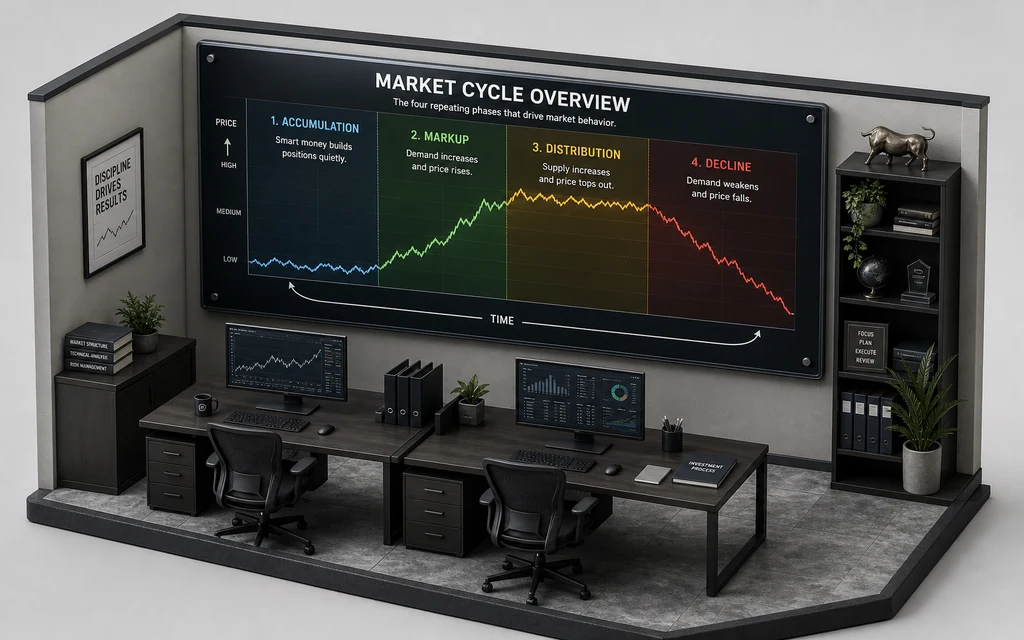
Drawing the chart…
Animation starts on scroll
In plain words
Picture a new city district. At first land is cheap, buyers are few, but professional developers are quietly buying plots — that's accumulation. Then a metro line and a mall are announced, everyone writes about the area, prices fly up and regular buyers arrive — that's the uptrend. Then the district is built out, prices peak, and developers calmly sell finished units to new owners — distribution. After that prices settle back to reasonable levels, opening a new circle for those who can wait. Stocks, oil and crypto live by exactly the same pattern — only the cycle runs faster and you can see it right on the chart.
The market doesn't move randomly — it cycles through four states. They repeat always, on any asset.
First, . Price stands still for a long time, nothing happens, nobody writes about the asset. That's exactly when big money quietly builds a position at a low price. The line price keeps bouncing from is the .
Then, the uptrend. Price breaks out of the range and everyone finds out: news, reviews, new buyers. Each high is above the last one and rises. This is the most visible phase, and it delivers the main result to those who entered earlier.
Next, . At the top price stops rising and starts moving back and forth in one corridor. Large participants are taking profit here. For an investor this is the signal: the target is reached, the result can be collected.
Finally, the downtrend. Price comes back to those base levels, and the circle closes: accumulation again, a quiet low-price entry zone again. So the phases are not four separate events but one repeating cycle where it's always clear what to do next.
Common beginner mistakes
- Judging the phase from a single candle instead of the whole range and volume picture
- Waiting for trend confirmation when price has already run through the entire second phase
- Confusing a wide band at the top with a continuation of the uptrend
- Watching price only and ignoring volume