Block 05 · 02
Take-Profit and Stop-Loss
Two levels set in advance that lock in your outcome: where to take profit and where to protect your capital.
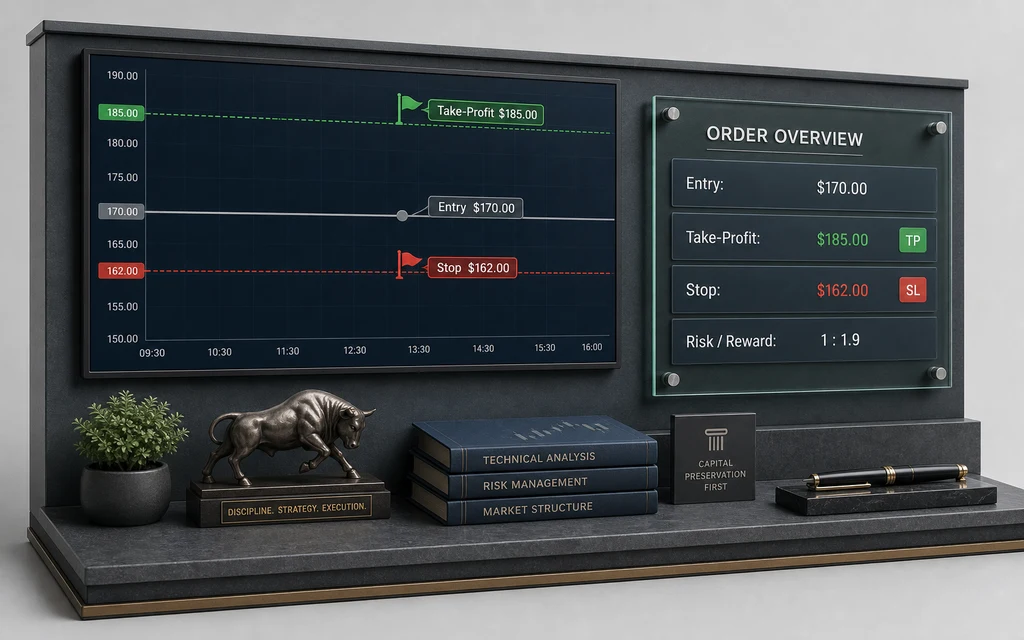
Target locked in
The exchange closes the position itself and sends profit to your account. No need to watch the screen.
Opening point
The entry level is chosen from the chart once the asset itself is confirmed.
Pre-set boundary
The level where the trade closes automatically and capital returns to the free balance for the next idea.
Both levels are set before opening the trade — the decision is made calmly and executed automatically.
Animation starts on scroll
A take-profit is an exit level set in advance. Price reaches it, the order fires on its own, and the gain is booked without an in-the-moment decision.
A hypothetical example. Entry at $100. Move the levels and see how the balance between the potential up move and down move changes.
A stop loss sets in advance the level at which the position will be closed to limit the loss.
A take profit sets the level at which the position can be closed to book the result.
There is no universal 'correct' level: levels depend on the asset, the market situation and the parameters of a specific strategy.
In plain words
Let's walk through a finished trade. Entry at $100. Analysis shows the nearest strong resistance zone is $118, and the support level the price has bounced off twice is $94. The investor sets a take-profit at $118 and a stop at $94 right when opening the position. Then they close the terminal and go about their day. Two weeks later, the price hits $118 at three in the morning — the exchange closes the position and credits $18 per share. The investor was asleep at the time. Both levels had been calculated in advance and worked for them around the clock.
and -loss are two price levels you set before opening a trade. From then on, the exchange executes them for you automatically.
Take-profit is the level where you lock in profit. You decide in advance: "my target is $118." When the price reaches that mark, the position closes itself and the result is credited to your account. There's no need to watch a screen — the trade executes at night or while you're busy with something else.
A stop is the boundary of the trade, set in advance. It's the point at which the position closes automatically, and the capital returns to your available balance, ready to work again. Your capital doesn't stay locked into an idea that no longer fits the plan.
The main value of both levels is that the decision is made in advance, with a clear head, based on the numbers from your analysis. When the market is actually moving, there's nothing left for you to decide — the plan executes on its own.
Common beginner mistakes
- Opening a position without set levels — then the decision has to be made in the heat of the moment
- Setting the target closer than the boundary — the ratio works against the plan
- Moving the boundary farther from entry after the trade is opened
- Setting levels at round numbers instead of real zones on the chart