Block 01 · 02
The Buy and Sell Buttons: What's Behind Them
Two buttons on the platform — two ways to profit: on the way up and on the way down. We explain how you can sell something you don't own.
- 01Entry at $100
- 02Price moves up
- 03Close at $115 — Close
+$15 per share
- 01Entry at $100
- 02Price moves down
- 03Close at $85 — Close
+$15 per share
Direction differs — the mechanics are the same: entry, price move, close. A result appears in both scenarios, so the market works in any phase.
On an exchange a buyer and a seller meet. Pressing the button is only the start of the order's path inside the trading system.
The user submits a buy order.
Buyer ↔ Seller → Matching
This continues the idea from the first lesson: a buyer and a seller meet on the market and the system matches their orders.
In plain words
A gold bar held in a bank vault is standardized — there are thousands like it on the market, and each is equivalent to any other. The owner doesn't plan to touch it for the next year and allows the bank to lend the bar out for a fee. You take the bar and sell it today at the market price of $2,400 an ounce. A month later, the price is $2,200 an ounce. You buy an identical bar on the market for less and return it to the owner: their bar is back in place plus a lending fee, and you keep the price difference. That's exactly how a short position works — complicated only in words.
The market can move in both directions
On an exchange, the price can rise or fall — and in both cases there's an opportunity to open a position.
If you click , you open a position expecting the price to rise. Bought an asset at $100, it grew to $130 — the $30 difference becomes your result.
But the market doesn't have to rise. That's why there's a second direction — . In this case, you open a position expecting the price to fall. The asset was worth $100, the price dropped to $70 — the $30 move now works in your favor.
Buy — working on the upside
Buy means working on a price increase.
Entry at $100, exit at $130 — the result from the move is $30 per share.
Sell — working on the downside
Sell means working on a price decline.
Entry at $100, exit at $70 — the result is the same $30 per share, only the move happened downward.
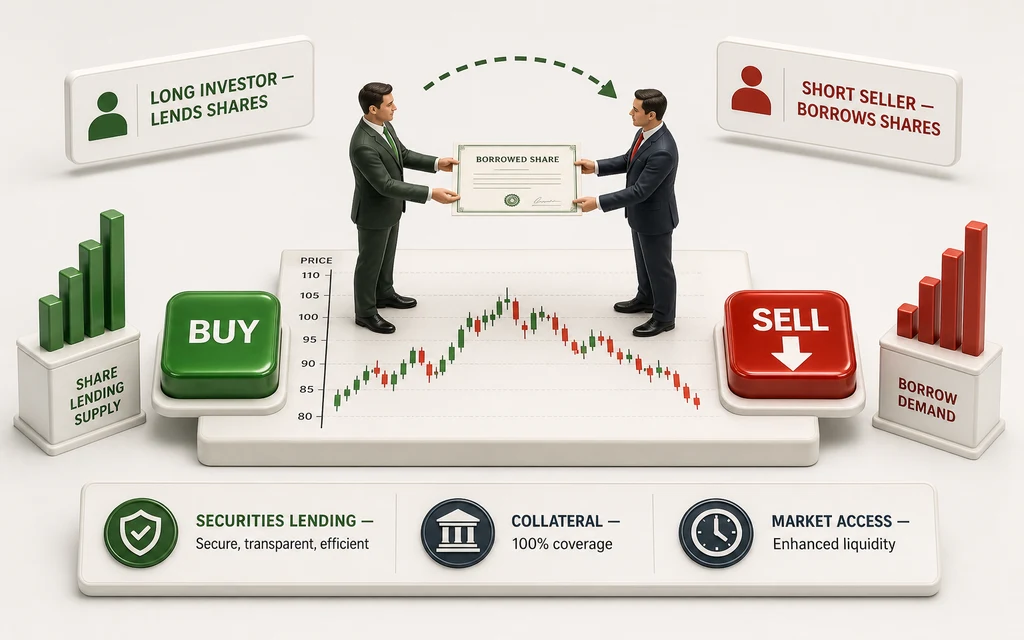
How to sell something you don't own
Shares for a short position can be temporarily borrowed through the market's infrastructure. Large holders lend securities through the securities lending mechanism, and after the position closes, the shares are returned to the lender.
So Sell isn't "selling thin air" — it's a full-fledged stock market mechanism.
The bottom line
Buy — working on a rise. Sell — working on a decline.
Fundamental and technical analysis help determine the direction, and Buy and Sell turn that decision into a concrete position. That's why the market doesn't have to rise for an opportunity to appear.
Common beginner mistakes
- Fearing the Sell button as something fraudulent — in reality it's a fully legal and transparent mechanism
- Thinking you have to nail the exact moment to click — entry and exit levels are discussed in advance, without rushing
- Believing you can only profit when the price rises — the market offers opportunities when the price falls too