Block 03 · 02
Critical Mass of Capital
Three stages of an investor's journey: accumulation, working the account, and the moment capital starts working for you.
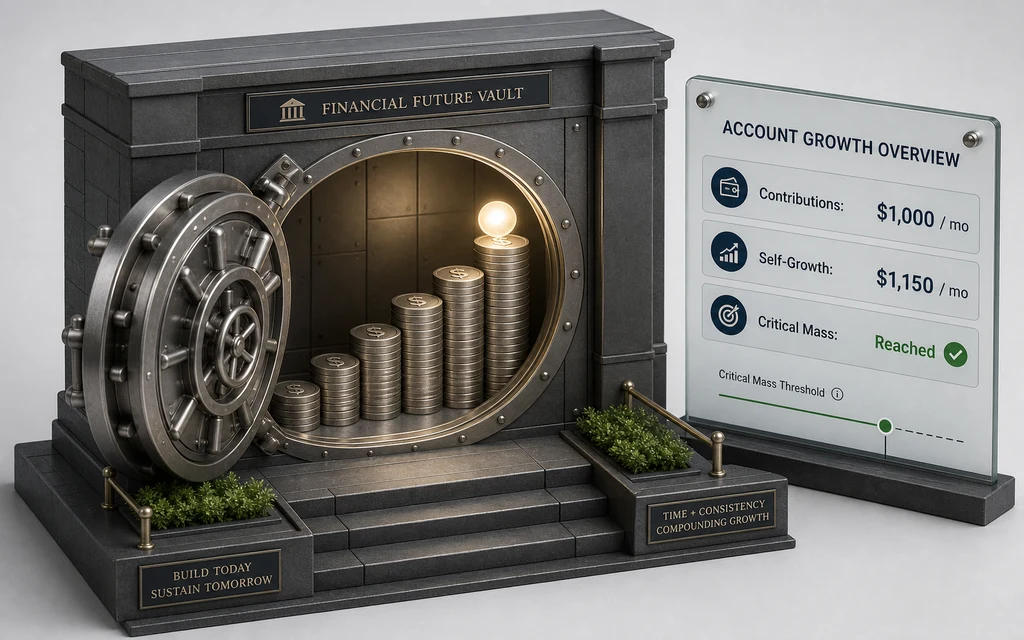
Critical mass comes from time and keeping the base intact: the longer capital works in full, the faster the account grows on its own.
Choose the capital that is available to act with right now.
The market repriced the company. There is now a chance to study the asset at a lower price. That does not mean the asset will rise.
The opportunity is the same. The difference is the capital available at the moment it appears.
The market does not wait until you are ready. Opportunities appear when they appear. Capital is not only a way to get a result from opportunities you already found. It is the ability to act when the right moment actually arrives.
You cannot count on the next opportunity appearing at a moment that suits you.
The assumed return is an educational parameter only. All scenarios are hypothetical and are not investment advice.
In plain words
Take actual numbers. At a 5% monthly return, a $2,000 account produces $100 — a real amount, but not one that changes much. The same percentage on a $40,000 account produces $2,000 a month — income comparable to a full salary, at the same percentage and the same strategy. The difference isn't in skill or leverage — it's purely the size of the base. That's exactly why the first few months are devoted to building up the account's core: the percentage stays the same, but the outcome differs by a factor of twenty.
There's a point after which an account starts growing on its own, without your contributions. It's called , and the goal of the first few months is to reach it.
Why size matters more than percentage at first. 10% of a small sum adds almost nothing, while 10% of an already-built base is a meaningful result. That's why, at the start, consistency of contributions matters more than the rate of return.
Three stages. The first three months are for building the base — the account's core isn't touched. The next two to three months are systematic work: allocation across instruments, a plan with a specialist, repeatable results. After that, the account's returns exceed your contributions, and part of the profit can be withdrawn while the base stays intact.
The key resource here is time and keeping the base intact. Every dollar that stays at work increases the amount your return is calculated on in the following period.
Common beginner mistakes
- Chasing a higher percentage when the outcome is driven by the size of the base
- Withdrawing large sums from the account's core during the accumulation stage
- Planning a withdrawal on the spur of the moment instead of in advance with a specialist
- Judging the accumulation stage by a single trade instead of the base's trajectory